
VPS Tutorials
Home Broadband VPS vs. Home Broadband VDS vs. Bare-Metal Dedicated Servers (2026): Breaking Down Resource Types and Use Cases
Many people see terms like home broadband VPS, home broadband VDS, dual-ISP residential IP, and dedicated bare-metal server and instinctively assume they are just "slightly more expensive VPS." The real place people go wrong isn't CPU or RAM—it's not understanding that the underlying resource types are fundamentally different: some are shared VPS, some are carved-out home broadband VDS, and some are exclusive bare-metal dedicated servers. This article breaks down the resource structure, IP logic, use cases, and pitfalls of all three.
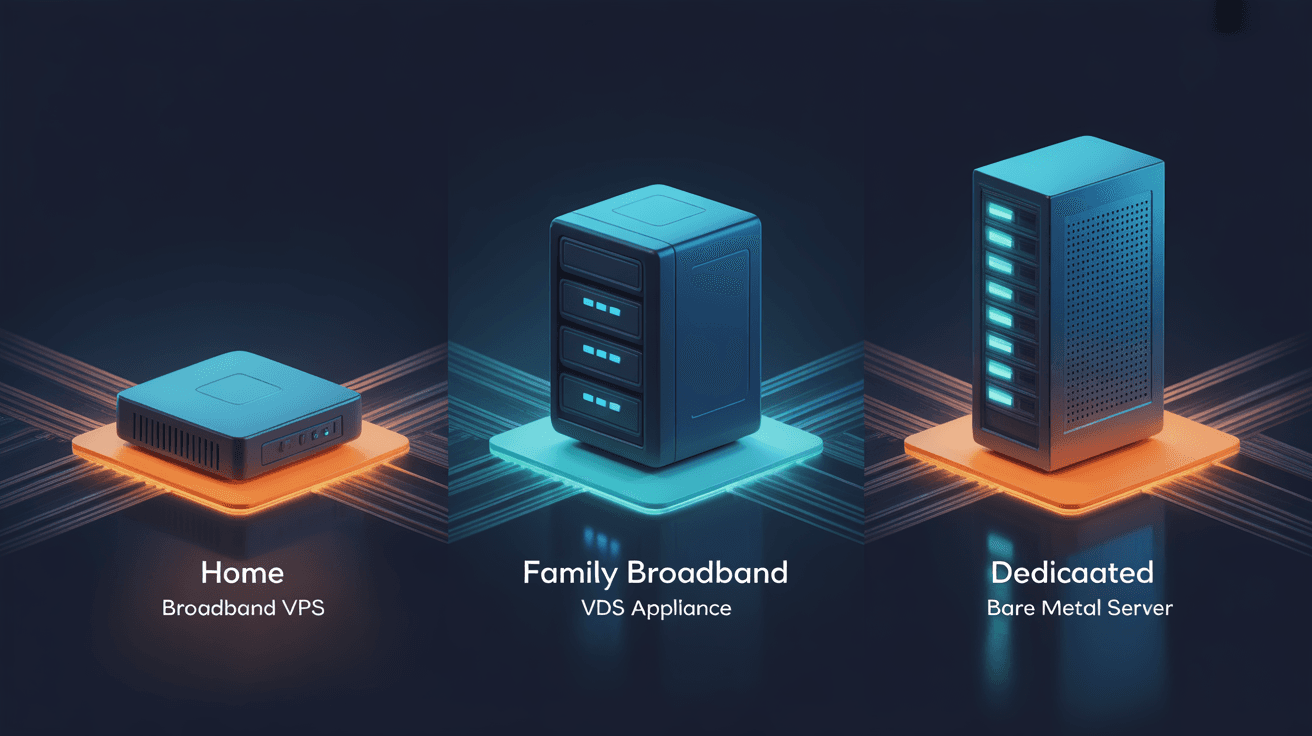
When many people first see these product names, they usually assume they are all about the same:
- Home broadband VPS
- Home broadband VDS
- Dual-ISP residential IP
- Bare-metal dedicated server
- Physical machine
On the product pages, everyone writes:
- Native IP
- Residential IP
- Home broadband environment
- Strong unblocking
- Good TikTok data
- Supports Windows installation
So the most common misjudgment is:
- Aren't these just VPS with different names from different vendors, essentially all the same?
Actually, no.
The biggest difference behind these terms isn't the size of the specs, but:
- How resources are allocated
- Where the IP comes from
- Whether you're getting a shared virtual machine, a slice of home broadband, or an entire physical host
Once you don't understand this layer, it's easy to run into these problems later:
- You think you bought a residential IP environment, but it's actually more like an ordinary native VPS
- You need stable long-term login, but you bought a line better suited for rotation or testing
- You need a large number of residential IPs, but you bought a single small VPS
- What you really want is bare-metal host resources, but you bought a VDS only suitable for lightweight use
So the focus of this article isn't specs, but breaking down the three resource types:
- What a home broadband VPS is
- What a home broadband VDS is
- What a bare-metal dedicated server is
And: who each is suited for, and who it isn't.
1) The conclusion first: the biggest difference among these three isn't "whether it's a residential IP," but "which layer of resources you're getting"
Here's the simplest way to remember it:
- Home broadband VPS: You get a small VPS leaning toward a residential/native environment
- Home broadband VDS: You get a more clearly defined resource slice carved out of a home broadband or residential network environment
- Bare-metal dedicated server: You get an entire server or an underlying host resource capable of carrying a large number of residential IPs
In other words:
- VPS is more like the "end-user usage layer"
- VDS is more like the "slice layer closer to the line itself"
- Bare-metal host / physical machine is more like the "underlying carrier layer"
None of these is necessarily more advanced—it's about which one better fits your business scale.
Home broadband VPS is the most common and easiest to understand.
It's essentially still a VPS:
- Fixed CPU, RAM, disk, and bandwidth configuration
- You use it directly to install an OS, run business workloads, log in via remote desktop, and deploy environments
Its difference from an ordinary data center VPS is mainly:
- The IP background is closer to home broadband / native / residential networks
- Vendors emphasize local service unblocking capability
- Some products emphasize dual ISP, static/dynamic, and home broadband attributes
Suited for:
- People who want to directly use one machine to run their business
- Users who need a residential/native environment but don't need many IPs
- Users doing social media, streaming, local services, and account environments
- People who don't want to deal with underlying host configuration
- Easiest to get started with
- Intuitive specs
- Relatively mature purchase and delivery process
- Better suited for single-machine business scenarios
- Usually not many IPs
- Better suited for "using" than for "distributing resources at scale"
- If you need to manage a large number of residential IPs, a single home broadband VPS quickly becomes insufficient
In one sentence:
- A home broadband VPS is more like an already-packaged end product.
3) What a home broadband VDS is: it's usually closer to the line resource itself than an ordinary VPS
The term VDS isn't necessarily fully consistent across vendors, but in the data you recently compiled, it usually has a very obvious characteristic:
- The product emphasizes "home broadband / residential line / static or dynamic residential IP attributes"
- Rather than purely emphasizing cloud platform compute
In other words, home broadband VDS often highlights these things more than an ordinary VPS:
- Dual ISP
- Home broadband
- Static residential / dynamic residential
- Switchable IP
- Closer to a real local end-user network environment
Because on the surface they look very similar:
- Also 1 core 1G, 2 cores 2G
- Also can install Windows
- Also can be managed remotely
But when you actually buy a VDS, what you're often buying isn't "compute cost-effectiveness," but:
- Line attributes
- IP environment
- Network profile
- Unblocking capability
Suited for:
- People very sensitive to IP quality and line attributes
- Users who need an environment closer to real home broadband
- People doing static residential, dynamic residential, IP switching, and local service unblocking
- People who value "environment" more than compute price-performance
- Often carries stronger residential environment characteristics
- Some products support IP switching or API switching
- Some clearly label static/dynamic
- Some products have stricter refund rules, with higher trial-and-error costs
So you can understand it as:
- VDS is often more like a "line-resource-oriented product"
Rather than simply a cheap VPS.
4) What a bare-metal dedicated server is: you're not buying "a small machine," but an entire underlying layer
Bare-metal servers, physical machines, and exclusive servers are on a completely different scale from the previous two.
Its core isn't:
- Whether 1 IP is good
- Whether 2 cores are enough
But:
- You get the entire machine
- You have larger-scale resources and higher controllability
- You can carry more IPs, more instances, and more uses
In the data you recently entered, the most typical examples are:
- 252 dual-ISP residential IP physical machine
- CERA bare-metal dedicated server
- Exclusive server resources
Suited for:
- Users who need a large number of residential IP resources
- People who need to deploy environments in bulk
- People who need stronger controllability and a larger resource pool
- People who need to split resources their own way
Not "faster," but:
- More controllable
- More scalable
- Better suited for batch and infrastructure-layer deployment
- Much higher price
- Usually slower to provision
- More dependent on your own operations capability
- Not the most worry-free choice for ordinary users who want to "buy and use"
So you can simply understand it as:
- A bare-metal dedicated server is more like an infrastructure-layer product, not a replacement for an ordinary end-user VPS.
You can understand them as a top-to-bottom structure:
- Closest to the end user
- Suited for directly running business
- Smallest resource scale
- Emphasizes lines and IP environment more
- Closer to the residential broadband resource itself
- Suited for people who need stronger residential attributes
- The lowest and heaviest layer
- Suited for carrying large amounts of resources and more flexible splitting
- Suited for large-scale residential IP business
If you just need "one machine for yourself," you usually won't start with a bare-metal host.
If you're already thinking about:
- 252 residential IPs
- Batch instances
- A large number of local environments
- Controllable delivery
Then an ordinary VPS / VDS may already be insufficient.
Many people see:
- 256GB RAM
- 4T NVMe
- 252 residential IPs
And think:
- Isn't this just a super-powerful VPS?
Actually, not at all.
What you're buying is:
- Physical machine resources
- Higher management complexity
- A larger resource pool
It's not suited for ordinary needs where you "just want to buy one machine to run daily business directly."
Many people only look at specs:
- 1 core 1G
- 2 cores 2G
And then think it's about the same as an ordinary VPS.
But the real value may be in:
- Static / dynamic
- Dual ISP
- Local broadband carrier
- Switchable IP
- Residential network profile
If you ignore these, you won't understand why you're paying more.
A home broadband VPS is better suited for direct use, and not necessarily for carrying:
- Batch residential IP business
- Large-scale multi-instance splitting
- A large matrix of account environments
If you already have needs at this scale, you should consider a lower-layer resource type.
Prioritize:
- Home broadband VPS
- Ordinary native/residential VPS
Because:
- Fast delivery
- Direct use
- Simple management
Scenario B: I need stronger residential broadband attributes, especially static / dynamic / IP switching
Prioritize:
- Home broadband VDS
- Dynamic residential / static residential lines
Because:
- Line attributes matter more than pure compute
- Better suited for local environments, platforms, unblocking, and risk-control scenarios
Prioritize:
- Bare-metal dedicated server
- Exclusive server resources
Because:
- You're no longer "buying one machine to use"
- You're buying an underlying platform that can carry large amounts of resources
No matter which one you buy, I suggest confirming at least these 8 things before ordering:
- Is this a VPS, VDS, or physical machine / bare-metal host?
- Is the core value you're buying compute, lines, or IP resources?
- Is it a static IP or a dynamic IP?
- Does it support IP changes / API?
- Is it dual ISP, and does it specify the carrier attributes?
- Are refunds returned to the original payment method, or only as balance?
- Is relay/transit usage recommended?
- Is delivery automatic or manual?
If you haven't clarified these, it's easy to buy and only then discover:
- You needed an environment, but bought compute
- You needed a large number of IPs, but bought a single machine
- You needed long-term stability, but bought a dynamic product better suited for testing
Names like home broadband VPS, home broadband VDS, and bare-metal dedicated server look like product naming differences.
But what really determines which one you should buy isn't the name, but:
- Which layer of resources you're getting
- Whether you actually want a single-machine environment, residential lines, or underlying carrying capacity
So a more reliable judgment order is:
- First look at your business scale
- Then look at whether you value compute, lines, or IP resources
- Then decide whether you should buy a VPS, VDS, or bare-metal dedicated server
If the order is right, you buy the right resource type; if the order is wrong, you're just buying the wrong product in a more expensive way.