
VPS Recommendations
Static Residential IP vs. Dynamic Residential IP vs. Native IP: How to Choose (2026) — Don't Buy These Terms Blended Together
Many people buying a VPS see the terms "residential IP," "native IP," and "dynamic IP" and assume they are different ways of saying the same thing. The real pitfall isn't vendor marketing — it's that you haven't clearly distinguished whether you need a long-term stable environment, a switchable IP, or simply a region-native attribute. This article breaks down the differences between static residential IPs, dynamic residential IPs, and native IPs, along with their use cases and the order in which to evaluate them.
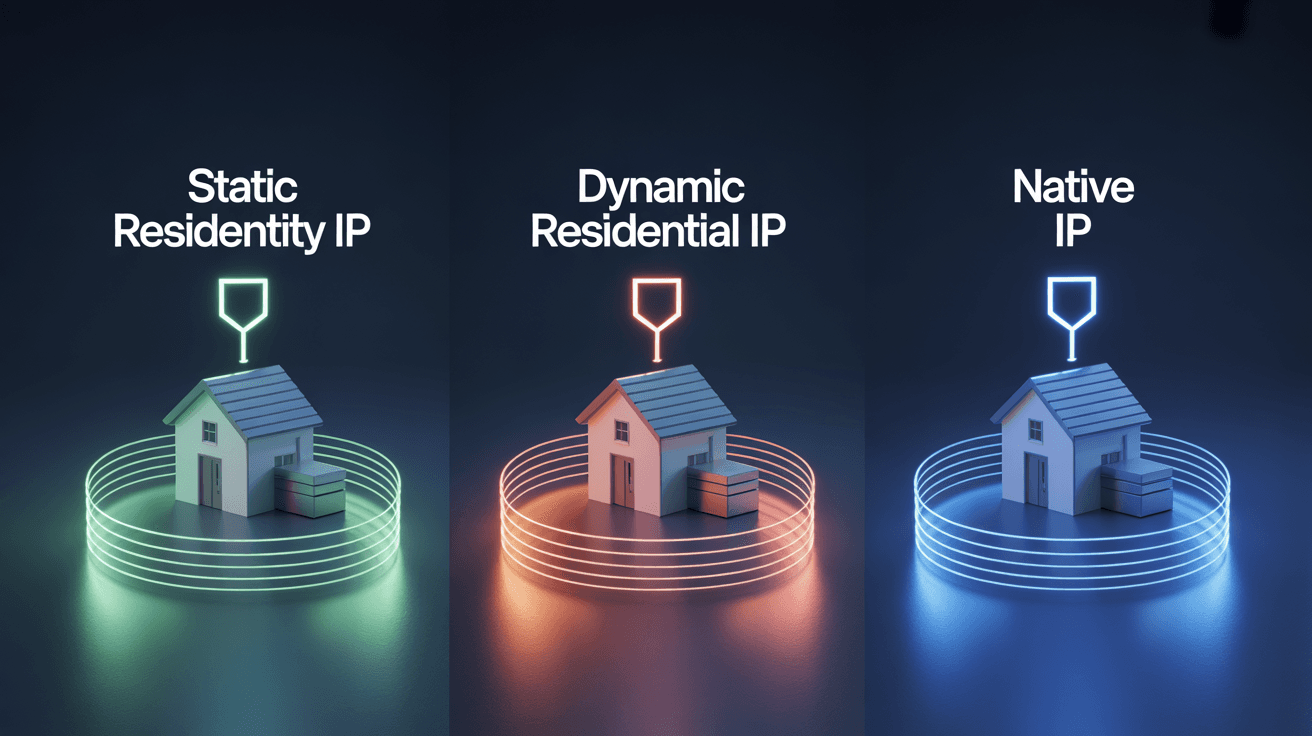
When buying a VPS, VDS, or residential line, people are most easily confused by a few terms:
- Static residential IP
- Dynamic residential IP
- Native IP
On the surface, all three terms relate to "IP quality," "local environment," and "unlocking capability," so many people naturally treat them as the same type of product with different vendor wording.
But when it comes time to place an order, a great many people buy the wrong thing.
Because they solve different problems:
- Some are better suited to long-term stable logins
- Some are better suited to switching IPs
- Some are better suited to local region attributes and basic unlocking
- Some don't necessarily carry residential attributes — they just have better region-native attributes
So if you order just because you see words like "native," "residential," "dual ISP," "dynamic," or "static," you can easily end up with three outcomes:
- You need a long-term stable environment but bought a dynamic IP
- You need to rotate IPs but bought a static residential IP
- You need a residential environment but only got an ordinary native IP
This article completely breaks down these three concepts so you know:
- What each of them actually is
- Which businesses each suits
- What order to judge them in
- Which marketing terms are most likely to mislead
1) The conclusion first: the difference between these three IP types isn't "which is more advanced" — it's "what problem are you actually trying to solve"
The simplest way to understand it is to remember this line:
- Static residential IP: suited to a long-term fixed environment
- Dynamic residential IP: suited to switching IPs and rotating environments
- Native IP: suited to clear region attributes, local services, and basic streaming unlocking, but doesn't necessarily carry residential attributes
In other words:
- Static / dynamic determines whether the IP changes
- Residential / native determines which type of source the network environment resembles
They are not three tiers on a single axis, but different product characteristics formed by the intersection of two dimensions.
If summarized in one practical sentence:
- First decide whether you want "stable" or "switchable," then decide whether you want a "residential environment" or "region-native attributes."
Static residential IP emphasizes two words:
- Static: the IP is fixed and doesn't change frequently
- Residential: closer to the terminal network environment of a home broadband operator
The most valuable thing about a static residential IP isn't "faster speed," but:
- The network environment looks more like a local home user
- The IP itself is more stable
- Long-term logins, local services, and local environments are easier to keep consistent
This type of product suits scenarios that need to maintain the same network profile over the long term.
- Long-term account environment operation
- Long-term logins to streaming and local services
- Ticketing and localized services
- Local-region social media operations
- Environment-type businesses that need "the IP not to change"
- Often labeled "static residential IP"
- Often labeled "home broadband VDS"
- Often labeled "local broadband operator"
- Often carries "balance-only refund" or stricter refund terms
In other words, what it mainly sells is:
- IP environment value
Not compute cost-performance.
A dynamic residential IP emphasizes:
- The IP can change
- Some can also be switched manually
- Some support changing IPs via API
It may still be a residential environment, but its biggest difference from static residential is:
- It emphasizes variability rather than fixity
- Businesses that need to rotate IPs
- Testing scenarios that need to switch environments quickly
- Social media and multi-environment verification
- Operational needs that must avoid long-term binding to the same address
- Flexible
- Switchable
- Better suited to users who need to try multiple environments
- Not suited to usage that strongly depends on a long-term fixed IP
- Environment consistency can sometimes be less stable than static residential
- The more frequently you switch, the more you need to understand the platform's risk-control logic yourself
So a dynamic residential IP isn't "stronger than static" — it's:
- Suited to different tasks.
If you need to rotate IPs anyway, a static residential IP may actually not suit you.
The term "native IP" is the most easily misused and misunderstood.
Many vendors write "native IP" as if it were a universal label, but the more accurate understanding is:
- It usually emphasizes that the IP's region attributes and network ownership are more natural and more like a local allocation, rather than necessarily emphasizing residential attributes
- More authentic region attributes
- More natural recognition by certain local platforms
- Usually friendlier for streaming, local services, AI platforms, and similar scenarios
This is the key point.
- Native IP ≠ residential IP
Some native IPs:
- Are non-residential
- But have very clean region attributes
- Perform very well at unlocking local services
So if what you want is:
- Japan region unlocking
- Korean local platforms
- A US native environment
- European local streaming
A native IP is often already sufficient.
But if what you want is:
- A profile more like a home broadband user
- Closer to a residential terminal network environment
Then you shouldn't just fixate on the word "native."
This is the most common situation.
What you originally wanted was:
- To keep one account logged in long-term
- Long-term logins to local services
- Not wanting the environment to change
But you bought a switchable, redial-capable, dynamic residential line.
The final problem isn't that the machine is bad, but that:
- It simply wasn't designed for a "long-term stable environment."
This is the exact opposite of the above.
If you need:
- To change IPs
- Multi-environment rotation
- API switching
Then a static residential IP often isn't suitable.
Its most valuable feature is "fixed," yet you want "change" — the direction was wrong from the start.
This is the third common misjudgment.
Many people think:
- Native IPs are clean
- Native IPs can also unlock
- So native IPs and residential IPs should be about the same
Actually they're not.
If your core demands are:
- A residential environment
- A home broadband profile
- Dual ISP home broadband characteristics
Then an ordinary native IP may not be able to replace a residential IP.
This is the most practical part.
Prioritize:
- Static residential IP
- Static home broadband VDS
- Dual ISP static residential line
Because what you care about most is:
- A fixed environment
- Stability
- Long-term login consistency
Prioritize:
- Dynamic residential IP
- Lines with manual IP switching
- Products that support IP switching via API
Because what you care about most is:
- Flexibility
- Rotatability
- Multi-environment operability
Prioritize:
- Native IP
- Lines explicitly labeled as region-native
- Local operators or regional backbone lines
Because what you value more is:
- Region recognition
- Streaming/platform/AI service unlocking
- Localized content scenarios
Then you need to look more closely:
- Is it residential?
- Is it static or dynamic?
- Is it dual ISP?
- Is it a local broadband operator?
Don't cut corners here — you must confirm each one.
Before ordering, it's advisable to confirm at least these 8 things:
- Is this a static or dynamic IP?
- Is this a residential IP or a native IP?
- Does it support IP switching? Does it support an API?
- Does it explicitly state the operator or residential attributes?
- Is it dual ISP?
- Is the refund rule an original-route refund or a balance-only refund?
- Does it support the platform or service you actually want to use?
- Is relay usage recommended, and how does it perform during peak evening hours?
If none of these questions are clarified, it's easy to end up with "the machine is fine, but it simply doesn't suit you."
This term is often used loosely.
What you should do isn't be swayed by the term, but keep asking:
- Is it actually native?
- Is it actually residential?
- Static or dynamic?
This kind of description can serve as a reference, but not as a conclusion.
Because whether it's ultimately good still depends on:
- Your region
- Your business model
- Your platform environment
- How you use it
Dual ISP has value, but it isn't necessarily more suitable for you just because it says dual ISP.
If you don't need a residential or home broadband environment at all, it may not be more worthwhile than an ordinary native IP.
9) Final word: the real difference between static residential, dynamic residential, and native IP isn't "good or bad" — it's "fit"
Many people buy the wrong machine not because the vendor deceived them, but because they misunderstood their own needs from the start.
A more reliable order of judgment should be:
- Do I actually want long-term stability, or switchability?
- Do I want a residential environment, or region-native attributes?
- Is my focus platform risk control, local services, or ordinary region unlocking?
Once you've clarified these three questions:
- Static residential IP
- Dynamic residential IP
- Native IP
Actually aren't hard to choose between.
The worst thing isn't the absence of good products, but that you've blended the answers to three different questions into a single purchasing action.