
VPS Recommendations
Student VPS Deals (2026): Complete Guide to the GitHub Student Pack + Cloud Server Discounts (Application, Pitfalls, Renewal, Migration)
When students buy a VPS, the biggest loss usually isn't "failing to get the lowest price" — it's getting a discount without a long-term plan: renewal prices double, the wrong region is chosen, and migration fails at expiry. This article breaks the GitHub Student Pack and common student discounts into an executable process: eligibility self-check, application paths, budget tiers, 7-day validation, and renewal and migration contingency plans, so you can turn discounts into stable productivity.
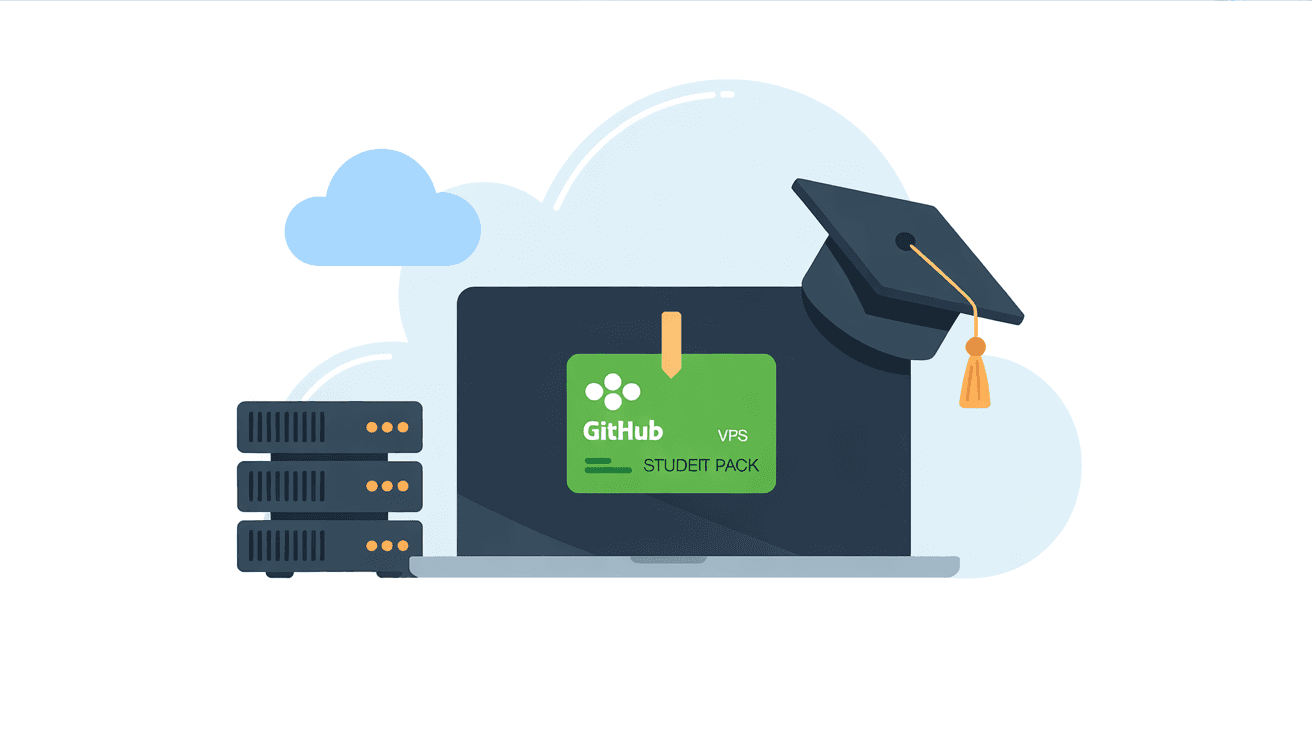
If you're a student, the most common misjudgments when buying a VPS are:
- Treating "cheap first month" as "cheap long term"
- Treating "it boots" as "it can be maintained long term"
I suggest a different mindset:
The goal of student discounts isn't to save the price of a meal — it's to lower the cost of 6-12 months of technical trial and error without wrecking later migrations.
This article is written to be actionable: from eligibility, application, budget, acceptance testing, renewal to migration, step by step.
| Discount type | Common sources | Who it suits | Main risks |
|---|---|---|---|
| Educational identity benefits | GitHub Student Developer Pack, etc. | Enrolled students, course projects | Requires verification; expiry/renewal applies |
| Vendor promotional discounts | Student-exclusive codes, education event pages, seasonal sales | Budget-sensitive users | Cheap first order, renewal may not be cheap |
| Trial credits | Cloud provider new-user credits | Short-term experiments/PoC | If you don't migrate at expiry, service stops or you get billed |
| General low-cost plans | Annual payment/low-cost monthly VPS | Running personal services long term | Cheap to start but check routing and stability |
So you shouldn't ask "which is cheapest" first — ask:
Will my project still exist in 6 months? If so, can I handle migration and renewal?
The student pack itself is valuable, but you must know it's a "collection of benefits," not a long-term stable plan.
Common thresholds:
- Requires verifiable enrolled-student status
- When a school email isn't available, you need to submit proof of enrollment
- Verification failures are usually related to document clarity and date validity
- Student status verification has a cycle; it must be re-verified after expiry
- Third-party benefits are provided by partners; content and rules may change
- Some benefits cannot be stacked or claimed repeatedly
This means:
- You can't treat a "temporary benefit" as a permanent dependency
- You must prepare a "fallback path after the benefit expires" before launching the service
Here's a 4-dimension scoring method you can use directly.
| Dimension | What to look at | Suggested weight |
|---|---|---|
| Total cost | First order + renewal + traffic + backup + migration | 40% |
| Stability | Evening peak jitter, packet loss, availability zone capacity | 30% |
| Maintenance complexity | Panel/images/automatic backup/rebuild speed | 20% |
| Discount sustainability | Discount validity, renewal conditions, whether migration is possible | 10% |
Many students' problem is simplifying the 40% "total cost" into "first-order price."
The truly money-saving approach factors in renewal and migration costs together.
If you haven't built this awareness yet, start here:
Suits:
- Course assignments
- Small blogs
- Bot/script experiments
Requirements:
- Accept occasional performance fluctuations
- Must have backups and rebuildable scripts
Suits:
- Graduation projects/portfolios
- Continuously updated personal projects
- Low-to-medium traffic APIs
Requirements:
- Passed evening peak validation
- Has a clear renewal budget
Suits:
- Multi-person collaborative projects
- Scenarios sensitive to online availability
Requirements:
- Monitoring and alerting are mandatory
- Drill-level backup and recovery are mandatory
If you only look at low prices and ignore network quality, you'll usually pay a "performance tax" later:
- Cheap VPS Recommendations (2026): How to Choose Under $3/Month?
- VPS Network Optimization in Practice (2026)
uname -a
nproc
free -h
df -h
ip -br a
curl -4 ifconfig.co || true
curl -6 ifconfig.co || true
traceroute -n <VPS_IP> | head -n 20
mtr -rwzc 200 <VPS_IP>
- Run access tests at two fixed periods (daytime/evening peak)
- Record average latency, 99th percentile, packet loss rate
- Observe whether CPU/memory peaks are controllable
-
SSH key login
-
Disable direct root login and password login
-
UFW minimal port policy
-
Fail2Ban basic protection
Confirm 3 things:
- You can accept the renewal price after the discount expires
- Backups can be successfully restored
- You can migrate to another machine within 1 hour
If you can't do item 3, this isn't a "sustainable solution."
- Only screenshotting the first-order price, without recording the renewal price and terms.
- Thinking about migration only halfway through the project, adding contingency plans when time is most expensive.
- Ignoring network paths, ending up with jitter that makes mainland-China access unusable.
- Treating free benefits as long-term commitments, then scrambling after expiry.
- No incident playbook, relying entirely on improvisation when problems occur.
Of these 5 pitfalls, the most expensive is #2.
I suggest filtering from the "migratable + renewable" angle:
If you want the big picture first, then pick a specific vendor:
- Do the eligibility self-check first (email/documents/age requirements)
- Record the discount validity period and renewal conditions
- Choose 2-3 candidate data centers for network comparison
- Run 7-day validation and keep logs
- Write a 1-hour migration runbook
- Complete renewal or migration 14 days before expiry
Just finishing these 6 items puts you ahead of 80% of "discount users."
Student discounts aren't a "freebie-hunting contest" — they're the best cost lever in the early stage of your technical growth.
The right approach is:
- Use discounts to lower trial-and-error costs
- Use validation to ensure the solution works
- Use migration capability to hedge against benefit changes
That way, you won't suddenly be knocked back to square one by an expiring discount or network fluctuations during course deadline week or before a project defense.